Buy roadstoculture.eu ?
We are moving the project
roadstoculture.eu .
Are you interested in purchasing the domain
roadstoculture.eu ?
domain@kv-gmbh.de · 0541-91531010
Buy roadstoculture.eu ?
Which song is used in the Ramazzotti Rosato advertisement?
The song used in the Ramazzotti Rosato advertisement is "Ti Sposerò Perché" by Eros Ramazzotti. This song is a romantic and uplifting track that complements the mood and theme of the advertisement, which is centered around love and celebration. The use of this song helps to create a memorable and emotional connection with the audience, enhancing the overall impact of the advertisement. **
Can the arts and crafts course still be completed?
Yes, the arts and crafts course can still be completed as long as the necessary materials and instructions are provided. Participants can follow along with video tutorials, written instructions, or attend virtual classes to learn and create art projects. Online platforms and resources make it possible for individuals to continue their artistic pursuits from the comfort of their own homes. With dedication and practice, participants can successfully complete the arts and crafts course and develop their skills. **
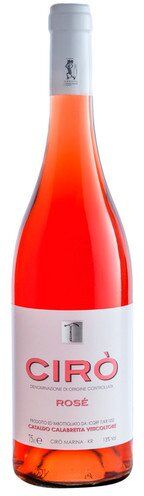

Similar search terms for Calabretta-Cataldo-Cirò-Rosato
Top-Angebote
Products related to Calabretta-Cataldo-Cirò-Rosato:
-
Rosato Calabretta 2025The Rosato from the Calabretta winery is a delicate, fresh, and fruity expression, vinified in pink and produced in Sicily in the municipality of Randazzo, on the northern slope of Mount Etna. This label is made from pure Nerello Mascalese grapes from ungrafted vines in the Calderara district. The vines, relatively young at about 5 years of average age, are cultivated at high altitudes using the low bush method on volcanic soils characterized by sandy soils mixed with stones and pebbles. The winery is a family-run business, owning about 10 hectares of vineyards, managed by father and son with great care and attention to the territory according to traditional methods and following the principles of organic farming. The Rosato di Calabretta is produced with carefully selected grapes that are hand-harvested at their perfect ripeness. The bunches, upon reaching the winery, are destemmed and subjected to the "pista e mutta", as it is called in the local dialect, meaning a quick pressing and immediate transfer of the must into stainless steel containers without allowing prolonged contact with the skins.stainless steel without allowing prolonged contact with the skins. The alcoholic fermentation takes place just like a white winemaking, in stainless steel containers, using exclusively indigenous yeasts, for a few weeks, after which the wine remains in aging in stainless steel tanks for a few months before being bottled and ready for marketing. The Rosato “Pista e Mutta” presents itself with a bright cerasuolo pink color. On the nose, intense aromas of small red fruits appear, including wild strawberries, cherries, and currants, floral notes of red flowers and Mediterranean scrub, spicy hints of mixed spices and white pepper, finishing with slight mineral hints. On the palate, it is rich, juicy, intense, and fresh, characterized by a beautiful minerality and a pleasantly fruity and persistent finish. This from the Calabretta winery is a sincere rosato, composed and balanced with aromas that are never excessive or showy, making it suitable for any occasion.16,00 £*Shipping: 48,00 £Secure redirect to the provider
-
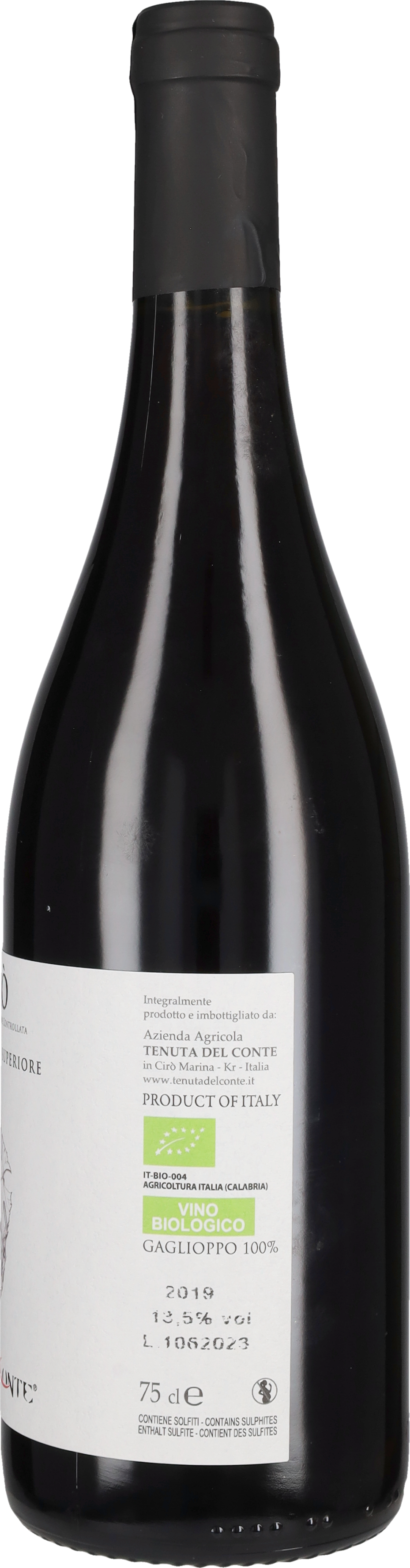
Cirò Rosso Classico Superiore Tenuta del Conte 2019from 40-year-old vines that rest on clay-limestone soils. In the vineyard, as already mentioned, the principles of organic farming are followed, using only small quantities of copper and sulfur. In the winery, all alcoholic fermentations occur spontaneously, followed in this case by aging for two years in steel tanks. The Cirò Rosso Tenuta del Conte presents itself in the glass with a light ruby color, typical of the grape variety. Mediterranean and engaging nose, with hints ranging from carob to licorice, from violet to sour cherry. On the palate, it surprises with how it manages to combine substance and dynamism, thanks especially to a beautifully textured tannin, which dries precisely, preparing for important meat-based dishes or intense sauces.from 40-year-old vines that rest on clay-limestone soils. In the vineyard, as already mentioned, the principles of organic farming are followed, using only small quantities of copper and sulfur. In the winery, all alcoholic fermentations occur spontaneously, followed in this case by aging for two years in steel tanks. The Cirò Rosso Tenuta del Conte presents itself in the glass with a light ruby color, typical of the grape variety. Mediterranean and engaging nose, with hints ranging from carob to licorice, from violet to sour cherry. On the palate, it surprises with how it manages to combine substance and dynamism, thanks especially to a beautifully textured tannin, which dries precisely, preparing for important meat-based dishes or intense sauces.23,00 £*Shipping: 48,00 £Secure redirect to the provider
-
Cirò Rosso Classico Superiore 'Etichetta Storica' Scala 2024The Cirò Rosso Classico Superiore “Etichetta Storica” is a product capable of narrating all the grace of the type and the grape variety from which it originates, the Gaglioppo, a great native of the Calabrian territory. A concentrated sip develops on a lively tannin, while the nose is dominated by aromas that recall the typical Mediterranean scrub of southern Italy. Scala, a winery located in Cirò Marina, in the province of Crotone, brings to life a label with an ancient profile, the result of sixty years of experience. The “Etichetta Storica” is a Cirò Rosso Classico Superiore that comes from the pure grapes of a great native Calabrian grape variety, the Gaglioppo. The vines of this variety, whose average age is around 30 years, grow in vineyards located about 200 meters above sea level, rooting in a clayey and calcareous soil, exposed to the south and southeast. The grapes, after harvest, are taken to the winemaking facilities of the Scala winery, where they are gently pressed, then macerated on the skins for 15 days and fermented in concrete. Always in concrete tanks the wine rests for a period ranging from 24 to 36 months, at the end of which it is ready to be bottled and marketed. The Cirò Rosso Classico Superiore Scala “Etichetta Storica” presents itself to the eye with a ruby color. The aromas that envelop the nose evoke sensations of Mediterranean scrub, alternating with more spicy and savory nuances. On the palate, it is full-bodied, harmonious, with a sip characterized by a pleasant freshness and a finely integrated tannic structure in the overall structure. A Calabrian wine with which the Scala winery, a production reality where innovative winemaking technologies and modern machinery combine with respect for local traditions and the enhancement of the territory, gives us the perfect label to accompany land-based menus.13,00 £*Shipping: 48,00 £Secure redirect to the provider


-
Should the religious heritage and Christian tradition of Europe be more clearly included in the European constitutional treaty?
The inclusion of religious heritage and Christian tradition in the European constitutional treaty is a complex and sensitive issue. While Europe has a rich history of Christian influence, it is also a diverse and secular society. Therefore, any inclusion of religious heritage should be done in a way that respects the diversity of beliefs and values within Europe. It is important to strike a balance that acknowledges the historical significance of Christianity while also upholding the principles of secularism and religious freedom. Ultimately, the decision should be made through careful consideration and dialogue among the diverse communities and stakeholders in Europe. **
-
What can you make in the first arts and crafts class with 5th and 6th grade students?
In the first arts and crafts class with 5th and 6th grade students, you can make simple and fun projects such as friendship bracelets, paper mache masks, or painted rock art. These projects are engaging and allow students to express their creativity while also learning basic crafting skills. Additionally, these projects can be completed within the class period and are suitable for students of varying skill levels. **
-
Is East Asian cuisine more varied than European cuisine?
Both East Asian and European cuisines are incredibly varied, with each region offering a wide range of flavors, ingredients, and cooking techniques. East Asian cuisine encompasses the diverse culinary traditions of countries such as China, Japan, Korea, and Thailand, each with its own unique dishes and flavors. Similarly, European cuisine is incredibly varied, with distinct culinary traditions in countries like Italy, France, Spain, and Greece. Ultimately, the variety of both East Asian and European cuisines is a result of the rich diversity of ingredients, cooking methods, and cultural influences found within each region. **
-
On which Jewish festivals are the Christian festivals based?
The Christian festivals of Easter and Pentecost are based on the Jewish festivals of Passover and Shavuot, respectively. Easter is linked to the Jewish Passover, as it commemorates the crucifixion and resurrection of Jesus, which occurred during the time of Passover. Pentecost, on the other hand, is based on the Jewish festival of Shavuot, which celebrates the giving of the Torah at Mount Sinai. Christians believe that the Holy Spirit descended upon the apostles on the day of Pentecost, which is why the Christian festival is based on this Jewish holiday. **

Are traditional crafts disappearing?
Traditional crafts are indeed at risk of disappearing due to various factors such as modernization, globalization, and changing consumer preferences. Many younger generations are not pursuing these crafts as careers, leading to a decline in the number of skilled artisans. Additionally, mass production and cheaper alternatives are making it difficult for traditional crafts to compete in the market. Efforts are being made to preserve and promote these crafts through initiatives like cultural heritage programs and artisan cooperatives. **
Are festivals dangerous?
Festivals can pose certain risks due to large crowds, potential for accidents, and sometimes excessive alcohol consumption. However, with proper planning, security measures, and responsible behavior, the risks can be minimized. It is important for festival-goers to stay aware of their surroundings, look out for each other, and follow safety guidelines to ensure a fun and safe experience. **
Top-Angebote
Products related to Calabretta-Cataldo-Cirò-Rosato:
-
Calabretta Cataldo Cirò Rosato L'Arciglione - Cataldo Calabretta 2025The Cirò Rosato by Cataldo Calabretta is a liquid that beautifully combines pulp and saline contribution, creating a truly authoritative territorial portrait. New energy flows into the world of Calabrian viticulture, which, thanks to the work and seriousness of a circle of producers that is gradually expanding, can enjoy a renewed momentum. After all, some of the expressions of Gaglioppo bottled by Cataldo and other 'enlightened' producers from the Cirò area manage to reach truly remarkable expressive levels, and even blind tastings can overshadow much more renowned and celebrated denominations and areas. Authoritative, compact, and incorruptible, Gaglioppo is obviously the prince of Cataldo's vineyard, cultivated without the aid of any chemical or synthetic substances, alongside Greco and Alicante. All of Cataldo's wines undoubtedly deserve to be tasted, bottles with a quality-price ratio that is hard to beat, and to always have in the cellar, even forgetting some. The Cirò Rosato is obtained from pure Gaglioppo grapes, coming from vinesraised in bush training on clay and limestone soil. In the vineyard, the principles of organic farming are followed, and after manual harvesting, in the winery, spontaneous alcoholic fermentation and a very brief maceration on the skins of only 3 hours take place. The liquid matures for 6 months in steel tanks on the fine lees. The Cirò Rosato Calabretta reveals itself in the glass with a captivating intense cherry color. Deep and multifaceted nose, where hints of crunchy red fruit, citrus peel, and briny breezes alternate. The sip, compact and cohesive, develops in a constant dialogue between freshness and pulp, without forgetting the truly considerable saline contribution. Sea, sun, and salt.14,00 £*Shipping: 48,00 £Secure redirect to the provider
-
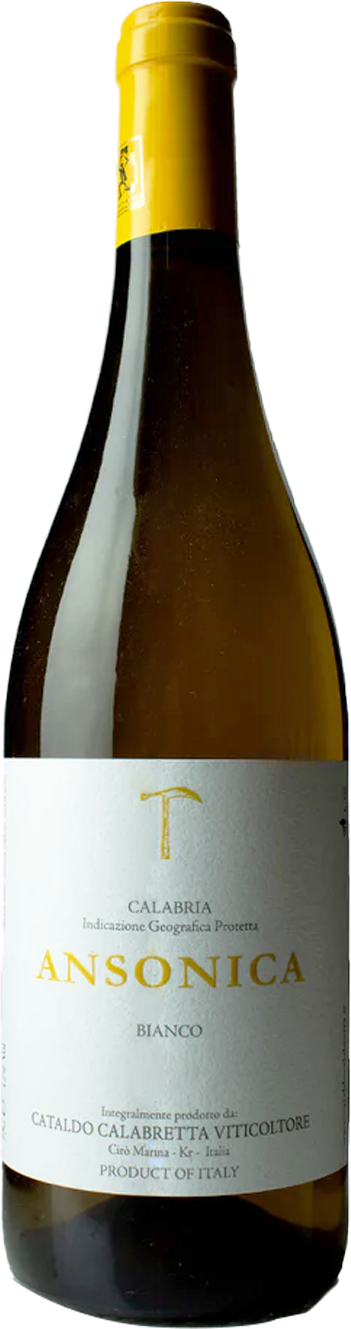
Calabretta Cataldo Cirò Bianco L'Arciglione - Cataldo Calabretta 2025The Cirò Bianco by Cataldo Calabretta is another example of how this young Calabrian winemaker has managed to enhance the territory from which he comes and the potential it offers. Cataldo's story begins far back, flowing slowly along the roots of his family, which has been producing wine in the countryside of Crotone for four generations; Cataldo, after studying oenology and viticulture in Milan, decided to give a new verve to the family business, immediately focusing on organic conversion and a production philosophy that allows space for the vineyard and the grapes. The interventions adopted by Cataldo and his sisters Maria and Michela in the hilly vineyards of Cirò Marina are minimal. The Cirò Bianco comes from vineyards over 20 years old, trained as bush vines on soils rich in limestone and clay; vineyards located 100 metersabove sea level, partially exposed to the North and partially to the South, enjoying a warm and dry climate and light breezes that flow slowly between the vineyards. Strictly manual harvest, spontaneous fermentation with indigenous yeasts, and aging for 6 months in steel on the lees: thus the Cirò Bianco by Cataldo Calabretta is born, a great example of Calabrian white wine that never disappoints thanks to its personality, its mineral verve, and its savory backbone. White flowers and yellow-fleshed fruit, persistence, and beautiful freshness: a white from Greco grapes waiting to be discovered…16,00 £*Shipping: 48,00 £Secure redirect to the provider
-
Rosato Calabretta 2025The Rosato from the Calabretta winery is a delicate, fresh, and fruity expression, vinified in pink and produced in Sicily in the municipality of Randazzo, on the northern slope of Mount Etna. This label is made from pure Nerello Mascalese grapes from ungrafted vines in the Calderara district. The vines, relatively young at about 5 years of average age, are cultivated at high altitudes using the low bush method on volcanic soils characterized by sandy soils mixed with stones and pebbles. The winery is a family-run business, owning about 10 hectares of vineyards, managed by father and son with great care and attention to the territory according to traditional methods and following the principles of organic farming. The Rosato di Calabretta is produced with carefully selected grapes that are hand-harvested at their perfect ripeness. The bunches, upon reaching the winery, are destemmed and subjected to the "pista e mutta", as it is called in the local dialect, meaning a quick pressing and immediate transfer of the must into stainless steel containers without allowing prolonged contact with the skins.stainless steel without allowing prolonged contact with the skins. The alcoholic fermentation takes place just like a white winemaking, in stainless steel containers, using exclusively indigenous yeasts, for a few weeks, after which the wine remains in aging in stainless steel tanks for a few months before being bottled and ready for marketing. The Rosato “Pista e Mutta” presents itself with a bright cerasuolo pink color. On the nose, intense aromas of small red fruits appear, including wild strawberries, cherries, and currants, floral notes of red flowers and Mediterranean scrub, spicy hints of mixed spices and white pepper, finishing with slight mineral hints. On the palate, it is rich, juicy, intense, and fresh, characterized by a beautiful minerality and a pleasantly fruity and persistent finish. This from the Calabretta winery is a sincere rosato, composed and balanced with aromas that are never excessive or showy, making it suitable for any occasion.16,00 £*Shipping: 48,00 £Secure redirect to the provider
-
Which song is used in the Ramazzotti Rosato advertisement?
The song used in the Ramazzotti Rosato advertisement is "Ti Sposerò Perché" by Eros Ramazzotti. This song is a romantic and uplifting track that complements the mood and theme of the advertisement, which is centered around love and celebration. The use of this song helps to create a memorable and emotional connection with the audience, enhancing the overall impact of the advertisement. **
-
Can the arts and crafts course still be completed?
Yes, the arts and crafts course can still be completed as long as the necessary materials and instructions are provided. Participants can follow along with video tutorials, written instructions, or attend virtual classes to learn and create art projects. Online platforms and resources make it possible for individuals to continue their artistic pursuits from the comfort of their own homes. With dedication and practice, participants can successfully complete the arts and crafts course and develop their skills. **
-
Should the religious heritage and Christian tradition of Europe be more clearly included in the European constitutional treaty?
The inclusion of religious heritage and Christian tradition in the European constitutional treaty is a complex and sensitive issue. While Europe has a rich history of Christian influence, it is also a diverse and secular society. Therefore, any inclusion of religious heritage should be done in a way that respects the diversity of beliefs and values within Europe. It is important to strike a balance that acknowledges the historical significance of Christianity while also upholding the principles of secularism and religious freedom. Ultimately, the decision should be made through careful consideration and dialogue among the diverse communities and stakeholders in Europe. **
-
What can you make in the first arts and crafts class with 5th and 6th grade students?
In the first arts and crafts class with 5th and 6th grade students, you can make simple and fun projects such as friendship bracelets, paper mache masks, or painted rock art. These projects are engaging and allow students to express their creativity while also learning basic crafting skills. Additionally, these projects can be completed within the class period and are suitable for students of varying skill levels. **
Similar search terms for Calabretta-Cataldo-Cirò-Rosato
-
Cirò Rosso Classico Superiore Tenuta del Conte 2019from 40-year-old vines that rest on clay-limestone soils. In the vineyard, as already mentioned, the principles of organic farming are followed, using only small quantities of copper and sulfur. In the winery, all alcoholic fermentations occur spontaneously, followed in this case by aging for two years in steel tanks. The Cirò Rosso Tenuta del Conte presents itself in the glass with a light ruby color, typical of the grape variety. Mediterranean and engaging nose, with hints ranging from carob to licorice, from violet to sour cherry. On the palate, it surprises with how it manages to combine substance and dynamism, thanks especially to a beautifully textured tannin, which dries precisely, preparing for important meat-based dishes or intense sauces.from 40-year-old vines that rest on clay-limestone soils. In the vineyard, as already mentioned, the principles of organic farming are followed, using only small quantities of copper and sulfur. In the winery, all alcoholic fermentations occur spontaneously, followed in this case by aging for two years in steel tanks. The Cirò Rosso Tenuta del Conte presents itself in the glass with a light ruby color, typical of the grape variety. Mediterranean and engaging nose, with hints ranging from carob to licorice, from violet to sour cherry. On the palate, it surprises with how it manages to combine substance and dynamism, thanks especially to a beautifully textured tannin, which dries precisely, preparing for important meat-based dishes or intense sauces.23,00 £*Shipping: 48,00 £Secure redirect to the provider
-
Cirò Rosso Classico Superiore 'Etichetta Storica' Scala 2024The Cirò Rosso Classico Superiore “Etichetta Storica” is a product capable of narrating all the grace of the type and the grape variety from which it originates, the Gaglioppo, a great native of the Calabrian territory. A concentrated sip develops on a lively tannin, while the nose is dominated by aromas that recall the typical Mediterranean scrub of southern Italy. Scala, a winery located in Cirò Marina, in the province of Crotone, brings to life a label with an ancient profile, the result of sixty years of experience. The “Etichetta Storica” is a Cirò Rosso Classico Superiore that comes from the pure grapes of a great native Calabrian grape variety, the Gaglioppo. The vines of this variety, whose average age is around 30 years, grow in vineyards located about 200 meters above sea level, rooting in a clayey and calcareous soil, exposed to the south and southeast. The grapes, after harvest, are taken to the winemaking facilities of the Scala winery, where they are gently pressed, then macerated on the skins for 15 days and fermented in concrete. Always in concrete tanks the wine rests for a period ranging from 24 to 36 months, at the end of which it is ready to be bottled and marketed. The Cirò Rosso Classico Superiore Scala “Etichetta Storica” presents itself to the eye with a ruby color. The aromas that envelop the nose evoke sensations of Mediterranean scrub, alternating with more spicy and savory nuances. On the palate, it is full-bodied, harmonious, with a sip characterized by a pleasant freshness and a finely integrated tannic structure in the overall structure. A Calabrian wine with which the Scala winery, a production reality where innovative winemaking technologies and modern machinery combine with respect for local traditions and the enhancement of the territory, gives us the perfect label to accompany land-based menus.13,00 £*Shipping: 48,00 £Secure redirect to the provider
-
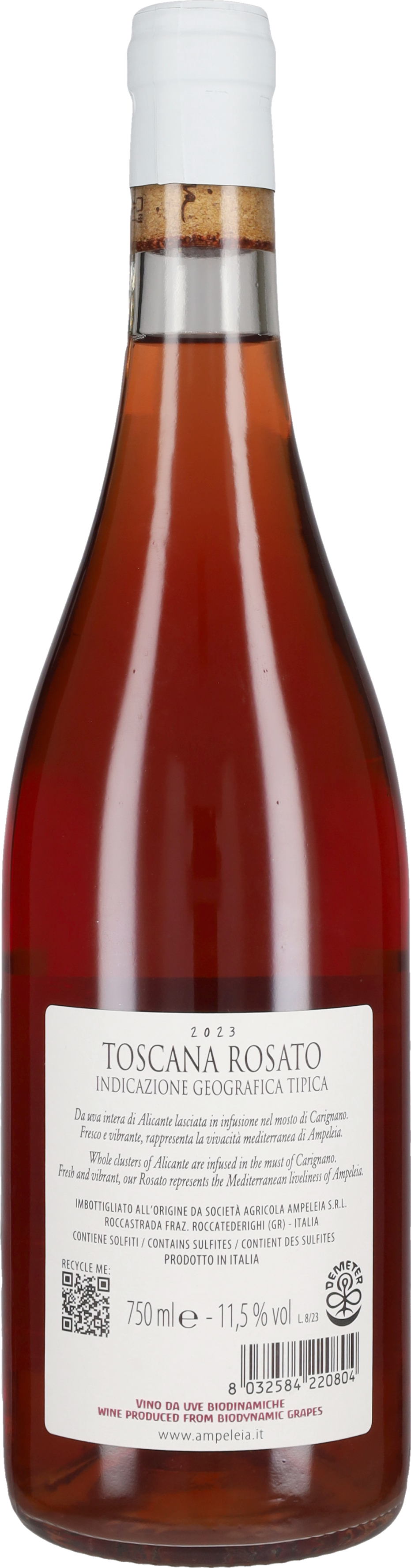
Rosato Ampeleia 2023Ampeleia's Rosato is immediately striking for its original personality, far from the banality of most conventional rosé wines, yet without sacrificing the classic smoothness that distinguishes the type. It is a blend of Carignano and Alicante Nero made in the Tuscan Maremma following biodynamic agriculture. The first vine in the blend is one of the most widespread varieties in the Mediterranean Basin, prized for its excellent resistance to hot and dry climates and for the powerful structure of the wines it gives rise to. In contrast, Black Alicante is one of the synonyms by which the Grenache grape variety is known, also grown in Spain under the name Garnacha, one of the noblest grapes in the world wine scene. Ampeleia Rosé comes from a blend of Carignano (80%) and Alicante Nero (20%) grapes, grown embracing the biodynamic vision within the Pieve vineyard, distinguished by an altitude of 250-300 meters above sea level and a clay, pebbly, calcareous and partly sandy soil matrix. Following manual harvesting, the grapes are transferred to the winery, where the whole clusters of Black Alicante are placed in infusion in the Carignano must so as to obtain a gentle extraction of the compounds they contain. The entire process, from spontaneous alcoholic fermentation to maturation for about 6 months, takes place in cement tanks. The color of Ampeleia's Rosé is deep, bright pink. Captivating aromas of red fruits and orange peel emerge from the glass, accompanied by seductive floral and mineral hints. The palate emerges for sparkling freshness, as well as good body, delicate tannin and rich, fragrant fruit. The fine sapid-mineral vein is also evident on the finish, contributing to the overall complexity of the taste.18,00 £*Shipping: 48,00 £Secure redirect to the provider
-
Cirò Rosso Riserva 'Dalla Terra' Tenuta del Conte 2016coming from vines over 40 years old that rest on red soil. In the vineyard, the dictates of organic farming are followed, therefore only small doses of copper and sulfur are allowed, along with natural preparations. In the winery, alcoholic fermentation occurs spontaneously, while aging takes place for 2 years in steel followed by 3 years in bottle, a choice that confirms the intention not to use wooden barrels. The “Dalla Terra” Cirò Rosso Riserva Tenuta Del Conte presents itself in the glass with a light ruby red color, which shifts towards orange. Undoubtedly the deepest and most layered nose among Mariangela's wines: a walk among wild herbs is immediately followed by another by the sea, surrounded by scrub, licorice, and ripe fruit. A full and vigorous sip, marked by an authoritative tannin, which cleanses the mouth and encourages another sip. It demands important pairings such as game or very aged cheeses. Rocky.coming from vines over 40 years old that rest on red soil. In the vineyard, the principles of organic farming are followed, therefore only small doses of copper and sulfur are allowed, along with natural preparations. In the winery, alcoholic fermentation occurs spontaneously, while aging takes place for 2 years in steel followed by 3 years in bottle, a choice that confirms the intention not to use wooden barrels. The “Dalla Terra” Cirò Rosso Riserva Tenuta Del Conte presents itself in the glass with a light ruby red color, shifting towards orange. Undoubtedly the deepest and most layered nose among Mariangela's wines: a walk among wild herbs is immediately followed by another by the sea, surrounded by scrub, licorice, and ripe fruit. A full and vigorous sip, marked by an authoritative tannin that cleanses the mouth and encourages another drink. It demands important pairings such as game or very aged cheeses. Rocky.37,00 £*Shipping: 48,00 £Secure redirect to the provider
-
Is East Asian cuisine more varied than European cuisine?
Both East Asian and European cuisines are incredibly varied, with each region offering a wide range of flavors, ingredients, and cooking techniques. East Asian cuisine encompasses the diverse culinary traditions of countries such as China, Japan, Korea, and Thailand, each with its own unique dishes and flavors. Similarly, European cuisine is incredibly varied, with distinct culinary traditions in countries like Italy, France, Spain, and Greece. Ultimately, the variety of both East Asian and European cuisines is a result of the rich diversity of ingredients, cooking methods, and cultural influences found within each region. **
-
On which Jewish festivals are the Christian festivals based?
The Christian festivals of Easter and Pentecost are based on the Jewish festivals of Passover and Shavuot, respectively. Easter is linked to the Jewish Passover, as it commemorates the crucifixion and resurrection of Jesus, which occurred during the time of Passover. Pentecost, on the other hand, is based on the Jewish festival of Shavuot, which celebrates the giving of the Torah at Mount Sinai. Christians believe that the Holy Spirit descended upon the apostles on the day of Pentecost, which is why the Christian festival is based on this Jewish holiday. **
-
Are traditional crafts disappearing?
Traditional crafts are indeed at risk of disappearing due to various factors such as modernization, globalization, and changing consumer preferences. Many younger generations are not pursuing these crafts as careers, leading to a decline in the number of skilled artisans. Additionally, mass production and cheaper alternatives are making it difficult for traditional crafts to compete in the market. Efforts are being made to preserve and promote these crafts through initiatives like cultural heritage programs and artisan cooperatives. **
-
Are festivals dangerous?
Festivals can pose certain risks due to large crowds, potential for accidents, and sometimes excessive alcohol consumption. However, with proper planning, security measures, and responsible behavior, the risks can be minimized. It is important for festival-goers to stay aware of their surroundings, look out for each other, and follow safety guidelines to ensure a fun and safe experience. **
* All prices are inclusive of VAT and, if applicable, plus shipping costs. The offer information is based on the details provided by the respective shop and is updated through automated processes. Real-time updates do not occur, so deviations can occur in individual cases. ** Note: Parts of this content were created by AI.