Buy roadstoculture.eu ?
We are moving the project
roadstoculture.eu .
Are you interested in purchasing the domain
roadstoculture.eu ?
domain@kv-gmbh.de · 0541-91531010
Buy roadstoculture.eu ?
Why was Francesco Schettino convicted?
Francesco Schettino was convicted for his role in the 2012 Costa Concordia cruise ship disaster, in which the ship ran aground off the coast of Italy, resulting in the deaths of 32 people. Schettino was found guilty of multiple charges, including manslaughter, causing a maritime disaster, and abandoning ship before all passengers and crew had been evacuated. His actions, including steering the ship too close to the shore and then abandoning it, were deemed reckless and negligent, leading to his conviction. **
Does Robin Schulz or Francesco Yates sing Sugar?
Robin Schulz is the artist who sings "Sugar," featuring Francesco Yates. Francesco Yates is a Canadian singer-songwriter who is featured on the track, providing the vocals alongside Robin Schulz. The song was released in 2015 and became a hit, reaching high positions on music charts around the world. **


Similar search terms for Francesco
Top-Angebote
Products related to Francesco:
-
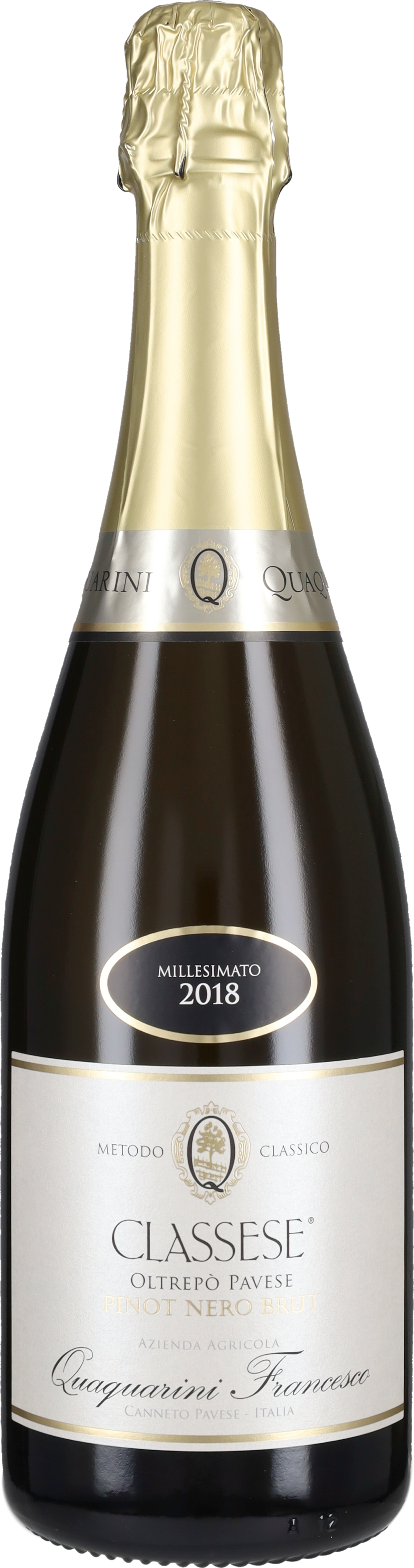
Quaquarini Francesco Spumante Metodo Classico Brut 'Classese' Francesco Quaquarini 2018Lo Spumante Brut “Classese” di Quaquarini è una bollicina piacevolmente fragrante, prodotta da una tradizionale cantina biologica situata tra le dolci colline dell’Oltrepò Pavese. Una bottiglia versatile, ideale per brindare durante le occasioni conviviali e per accompagnare in modo originale tutto il pasto. Un metodo classico fresco e diretto, che presenta allo stesso tempo una struttura consistente e ampia, che riesce ad esprimere in modo esemplare le caratteristiche di un territorio rurale antico, e una realtà familiare nella quale la coltivazione della vite si tramanda da più di tre generazioni. Francesco Quaquarini “Classese” si ottiene da un’attenta selezione delle migliori uve provenienti dalle parcelle di Pinot Nero della zona di Canneto Pavese. I vigneti sono situati nella fascia collinare più bassa, ad un’altitudine di circa 250 metri sul livello del mare. Qui, una viticoltura attenta all’ambiente e alle tecniche agricole locali garantisce una produzione eccellente. I terreni a media pendenza, con una buona composizione sabbiosa, permettono di ottenere grappoli sani e compatti, ideali per la produzione di spumanti fini ed aromatici. La vinificazione prevede una prima fermentazione in vasche di acciaio, e una seconda fermentazione in bottiglia con una successiva permanenza sui lieviti di 64 mesi. In questa fase si sviluppano le caratteristiche di complessità aromatica e la notevole struttura di questa interessante etichetta. Questa interpretazione del vitigno principe del metodo classico di Quaquarini è l’aperitivo frizzante ideale. La sua freschezza aromatica, di fiori bianchi e frutta fresca, lo rende estremamente interessante a inizio pasto e stimola l’accompagnamento a piatti a base di crostacei e pesce crudo. Nel calice presenta un colore giallo paglierino brillante con sfumature dorate. Il sorso è avvolgente, caratterizzato da un perlage cremoso e morbido, che riempie il palato con delicati aromi di pesca bianca e agrumi. Un finale lungo e finemente minerale, lasciano in bocca una sensazione di leggerezza e vivacità.22,00 £*Shipping: 48,00 £Secure redirect to the provider
-
Quaquarini Francesco Bonarda vivace 'Riva di Sass' Francesco Quaquarini 2024The Bonarda vivace “Riva di Sass” by Francesco Quaquarini is the most typical red of Oltrepò. It is the result of pure Bonarda grapes found on the hills of Canneto Pavese. Thus, an label inspired by the oldest traditions is born, but also capable of looking to the future, thanks to a biological viticulture that respects the environment. It is a healthy and genuine wine, made with simple winemaking and without the use of enological additives. Thanks to this care, the grape becomes the absolute protagonist of the scene, with its expressive and immediate varietal aromas. It is an ideal red to enjoy with a platter of flavorful local cured meats or with first courses with meat sauces.The “Riva di Sass” is a lively Bonarda, produced by a winery that offers straightforward wines with an authentic face. The estate Francesco Quaquarini is located in the Monteveneroso district of Canneto Pavese, in the heart of the Oltrepò hills. The territory has historically been suited for viticulture and still today is capable of producing very interesting bottles. The winery has always proposed labels faithful to the customs of the area. At the end of the harvest, the grapes of Croatina, Barbera, and Ughetta di Canneto, coming from vineyards cultivated under organic farming, are sent for fermentation in stainless steel tanks at controlled temperature, with skin maceration. The wine rests for a few months in stainless steel tanks and is bottled without the addition of sulfites, so that it can preserve the expressive integrity of the fruit.The lively Bonarda “Riva di Sass” by Francesco Quaquarini brings to the table the exuberant fragrance of the tradition of young and lively wines, typical of the lands of Oltrepò Pavese. The rustic and tannic profile of the grape variety is softened by the sweetness of the fruit and the sparkling verve, making it more pleasant and smooth. In appearance, it has a ruby red color with purple reflections. It captivates the nose with aromas of ripe cherry, blackberry, and wild berries, with slight spicy hints. The sip is jovial and inviting, with aromas of crunchy red fruit, fine tannins, and a harmonious, fresh, and lively finish. A true sip of the vineyard capable of giving the authentic taste of the terroir.11,00 £*Shipping: 48,00 £Secure redirect to the provider
-
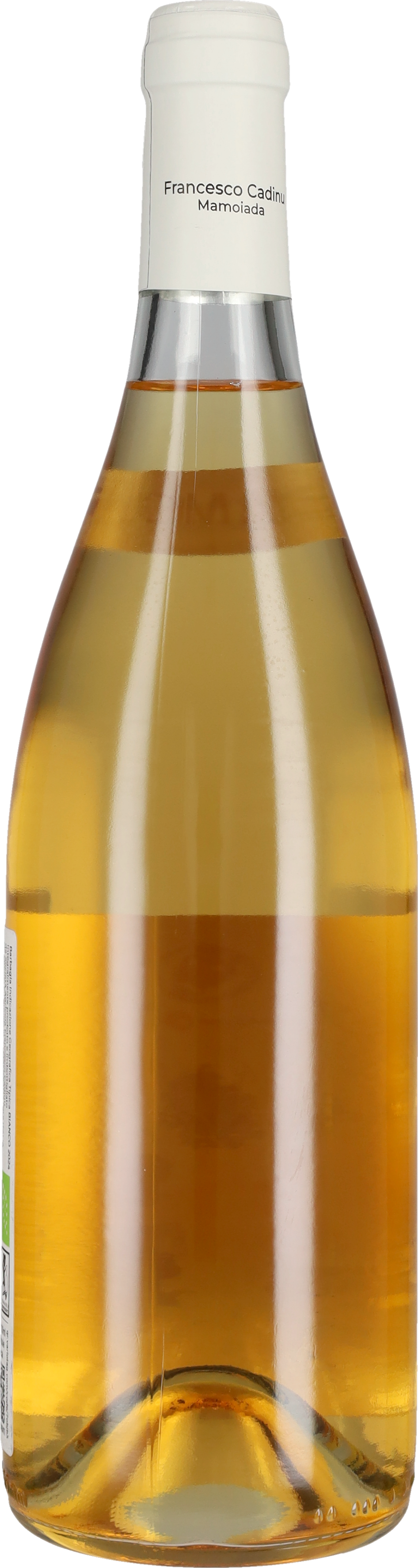
Bianco 'Mattio' Francesco Cadinu 2024The “Mattio” by Francesco Cadinu is produced in the province of Nuoro, particularly in Mamoiada, in the interior of the beautiful Sardinian island. The winery is family-run and operates in a land historically suited for wine production where grape cultivation has been practiced for centuries: it was the Phoenicians who cultivated the first vines of which we have records here. In 1950, an old vineyard in the “Fittiloghe” area was purchased, which today represents the productive heritage of the activity. The production philosophy is to work in respect of nature and the gifts it offers, in order to create top-quality products.The pure Granzza grapes of the “Mattio” by Francesco Cadinu represent one of the indigenous grapes that have been recovered and provide their maximum expression right in the Mamoiada area. The vines have an average age of about 50 years and are located at about 650 meters above sea level; the soil is mainly composed of granite, which gives a strong character to the final product. The harvest takes place in September and is manual. In the winery, spontaneous fermentation with indigenous yeasts is triggered, and the must macerates for 40 days on the skins.spontaneous alcoholic fermentation with indigenous yeasts, and the must macerates for 40 days on the skins. It ages for 4 months in terracotta amphorae.The color of the “Mattio” by Francesco Cadinu is an intense golden yellow with brilliant reflections; on the nose, one can sense aromatic herbs from the Mediterranean scrub, ripe yellow fruit, hints of citrus, and saline notes. On the palate, it is tasty, rich, and enveloping with pleasant iodized notes on the finish that linger delightfully in the mouth. It pairs perfectly with fried fish dishes, vegetarian dishes, and stewed white meats; excellent also with aged cheeses. A drinkable and inviting product, to be reserved for cheerful gatherings with lifelong friends to savor the authentic taste of Corsica.29,00 £*Shipping: 48,00 £Secure redirect to the provider
-
SAFAVIEH Couture Francesco 58-Inch Wood Drawer DeskFrancesco Drawer Desk: four-drawer storage, wood and metal construction and traditional pedestal silhouette The Francesco Drawer Desk is a drawer desk from SAFAVIEH Couture, the designer collection where silhouette, material and finish are...1037,73 $*Shipping: 0,00 $Secure redirect to the provider


-
Who is better, Paulo Dybala or Francesco Totti? If you don't know them, look them up.
Both Paulo Dybala and Francesco Totti are incredibly talented footballers, but it's difficult to compare them directly as they played in different eras and positions. Totti was a legendary playmaker and forward for AS Roma, known for his vision, passing, and scoring ability, while Dybala is a versatile forward known for his dribbling, creativity, and goal-scoring prowess. Both players have had significant impacts on their respective teams and have earned accolades for their performances. Ultimately, the question of who is better comes down to personal preference and the specific attributes one values in a player. **
-
Hello, who is better: Neymar or Francesco Totti? If you don't know these soccer players, watch videos of them.
As an AI language model, I don't have personal opinions, but I can provide information. Neymar and Francesco Totti are both highly skilled soccer players, but they have different playing styles and strengths. Neymar is known for his speed, dribbling, and goal-scoring ability, while Totti was known for his vision, passing, and leadership on the field. Both players have had successful careers and have made significant contributions to the sport. Ultimately, the answer to who is better is subjective and depends on individual preferences and opinions. **
-
Can the arts and crafts course still be completed?
Yes, the arts and crafts course can still be completed as long as the necessary materials and instructions are provided. Participants can follow along with video tutorials, written instructions, or attend virtual classes to learn and create art projects. Online platforms and resources make it possible for individuals to continue their artistic pursuits from the comfort of their own homes. With dedication and practice, participants can successfully complete the arts and crafts course and develop their skills. **
-
Should the religious heritage and Christian tradition of Europe be more clearly included in the European constitutional treaty?
The inclusion of religious heritage and Christian tradition in the European constitutional treaty is a complex and sensitive issue. While Europe has a rich history of Christian influence, it is also a diverse and secular society. Therefore, any inclusion of religious heritage should be done in a way that respects the diversity of beliefs and values within Europe. It is important to strike a balance that acknowledges the historical significance of Christianity while also upholding the principles of secularism and religious freedom. Ultimately, the decision should be made through careful consideration and dialogue among the diverse communities and stakeholders in Europe. **

What can you make in the first arts and crafts class with 5th and 6th grade students?
In the first arts and crafts class with 5th and 6th grade students, you can make simple and fun projects such as friendship bracelets, paper mache masks, or painted rock art. These projects are engaging and allow students to express their creativity while also learning basic crafting skills. Additionally, these projects can be completed within the class period and are suitable for students of varying skill levels. **
Is East Asian cuisine more varied than European cuisine?
Both East Asian and European cuisines are incredibly varied, with each region offering a wide range of flavors, ingredients, and cooking techniques. East Asian cuisine encompasses the diverse culinary traditions of countries such as China, Japan, Korea, and Thailand, each with its own unique dishes and flavors. Similarly, European cuisine is incredibly varied, with distinct culinary traditions in countries like Italy, France, Spain, and Greece. Ultimately, the variety of both East Asian and European cuisines is a result of the rich diversity of ingredients, cooking methods, and cultural influences found within each region. **
Top-Angebote
Products related to Francesco:
-
Quaquarini Francesco Bonarda vivace Francesco Quaquarini 2025La Bonarda di Francesco Quaquarini è un vino rosso frizzante, sincero nella sua espressione e dai lati femminili che sanno intrigare e rendono piacevole la beva. La Bonarda è una bella rappresentazione dell’Oltrepò Pavese e nasce dalle uve dei vigneti di Croatina, Barbera e Ughetta di Canneto, i quali si estendono in una delle zone più vocate alla coltivazione di uva. Tra i filari si segue un processo produttivo virtuoso che prevede il rispetto del regime biologico e di pratiche tradizionali e sostenibili. I lavori in cantina prevedono lo svolgimento della fermentazione alcolica delle uve in acciaio, la caratteristica effervescenza viene assunta attraverso il processo fermentativo in soluzione che genera l’anidride carbonica. L’affinamento prevede una breve sosta in acciaio. Si presenta con un colore rosso rubino e con schiuma e riflessi accattivanti di colore porpora. I profumi che evoca sono puliti e raffinati: ciliegia, mora selvatica, frutti di bosco. Al palato è morbido e avvolgente, animato da una piacevole effervescenza che lo rende dinamico e beverino, con note balsamiche di lunga persistenza. È una Bonarda versatile, ottimo accompagnamento a tutto pasto, ideale con salumi, insaccati e con i ricchi risotti della Pianura Padana. Si tratta di una Bonarda eccellente, perfetta espressione di un ampio terroir con le sue specificità.10,00 £*Shipping: 48,00 £Secure redirect to the provider
-
Quaquarini Francesco Sangue di Giuda 'Acqua Calda' Francesco Quaquarini 2025The Lombard producer Francesco Quaquarini presents the Sangue di Giuda ‘Acqua Calda’, a peculiar sweet sparkling red wine with an engaging drinkability. The grapes destined for this label come from the historic plot of Sangue di Giuda ‘Vigna Acqua Calda’, named after the Acqua Calda road, an ancient spa area. The Sangue di Giuda from Oltrepò Pavese, until 2010 considered a type of the Oltrepò Pavese denomination, is a DOC that mainly involves the use of Barbera and Croatina to create a sparkling or sparkling dessert wine. Francesco Quaquarini Sangue di Giuda ‘Acqua Calda’ comes from a blend of Croatina (65%), Barbera (25%), and Ughetta di Canneto (10%), the name that the Vespolina grape takes locally. The vines are cultivated under certified organic regime in the municipality of Canneto Pavese, on hilly sandy soils located at an altitude of 240 meters above sea level. The harvest is done by hand, and in the winery, the alcoholic fermentation is accompanied by 4-8 days of maceration on the skins at a temperature between 25 and 28 °C, followed by the complete malolactic fermentation. The wine is then subjected to refermentation in the bottle and, after a short rest, marketed. The Sangue di Giuda ‘Acqua Calda’ by Francesco Quaquarini has a bright and intense ruby red color. On the nose, vivid and harmonious fruity aromas are perceived, particularly of red berries, enriched by fine floral hints. Elegant and pleasant taste, light and fresh, characterized by the right sweetness and excellent structure. The recommendation is to enjoy this Sangue di Giuda alone at the end of the meal or at the table paired with spicy cheeses or small pastries.11,00 £*Shipping: 48,00 £Secure redirect to the provider
-
Quaquarini Francesco Spumante Metodo Classico Brut 'Classese' Francesco Quaquarini 2018Lo Spumante Brut “Classese” di Quaquarini è una bollicina piacevolmente fragrante, prodotta da una tradizionale cantina biologica situata tra le dolci colline dell’Oltrepò Pavese. Una bottiglia versatile, ideale per brindare durante le occasioni conviviali e per accompagnare in modo originale tutto il pasto. Un metodo classico fresco e diretto, che presenta allo stesso tempo una struttura consistente e ampia, che riesce ad esprimere in modo esemplare le caratteristiche di un territorio rurale antico, e una realtà familiare nella quale la coltivazione della vite si tramanda da più di tre generazioni. Francesco Quaquarini “Classese” si ottiene da un’attenta selezione delle migliori uve provenienti dalle parcelle di Pinot Nero della zona di Canneto Pavese. I vigneti sono situati nella fascia collinare più bassa, ad un’altitudine di circa 250 metri sul livello del mare. Qui, una viticoltura attenta all’ambiente e alle tecniche agricole locali garantisce una produzione eccellente. I terreni a media pendenza, con una buona composizione sabbiosa, permettono di ottenere grappoli sani e compatti, ideali per la produzione di spumanti fini ed aromatici. La vinificazione prevede una prima fermentazione in vasche di acciaio, e una seconda fermentazione in bottiglia con una successiva permanenza sui lieviti di 64 mesi. In questa fase si sviluppano le caratteristiche di complessità aromatica e la notevole struttura di questa interessante etichetta. Questa interpretazione del vitigno principe del metodo classico di Quaquarini è l’aperitivo frizzante ideale. La sua freschezza aromatica, di fiori bianchi e frutta fresca, lo rende estremamente interessante a inizio pasto e stimola l’accompagnamento a piatti a base di crostacei e pesce crudo. Nel calice presenta un colore giallo paglierino brillante con sfumature dorate. Il sorso è avvolgente, caratterizzato da un perlage cremoso e morbido, che riempie il palato con delicati aromi di pesca bianca e agrumi. Un finale lungo e finemente minerale, lasciano in bocca una sensazione di leggerezza e vivacità.22,00 £*Shipping: 48,00 £Secure redirect to the provider
-
Quaquarini Francesco Bonarda vivace 'Riva di Sass' Francesco Quaquarini 2024The Bonarda vivace “Riva di Sass” by Francesco Quaquarini is the most typical red of Oltrepò. It is the result of pure Bonarda grapes found on the hills of Canneto Pavese. Thus, an label inspired by the oldest traditions is born, but also capable of looking to the future, thanks to a biological viticulture that respects the environment. It is a healthy and genuine wine, made with simple winemaking and without the use of enological additives. Thanks to this care, the grape becomes the absolute protagonist of the scene, with its expressive and immediate varietal aromas. It is an ideal red to enjoy with a platter of flavorful local cured meats or with first courses with meat sauces.The “Riva di Sass” is a lively Bonarda, produced by a winery that offers straightforward wines with an authentic face. The estate Francesco Quaquarini is located in the Monteveneroso district of Canneto Pavese, in the heart of the Oltrepò hills. The territory has historically been suited for viticulture and still today is capable of producing very interesting bottles. The winery has always proposed labels faithful to the customs of the area. At the end of the harvest, the grapes of Croatina, Barbera, and Ughetta di Canneto, coming from vineyards cultivated under organic farming, are sent for fermentation in stainless steel tanks at controlled temperature, with skin maceration. The wine rests for a few months in stainless steel tanks and is bottled without the addition of sulfites, so that it can preserve the expressive integrity of the fruit.The lively Bonarda “Riva di Sass” by Francesco Quaquarini brings to the table the exuberant fragrance of the tradition of young and lively wines, typical of the lands of Oltrepò Pavese. The rustic and tannic profile of the grape variety is softened by the sweetness of the fruit and the sparkling verve, making it more pleasant and smooth. In appearance, it has a ruby red color with purple reflections. It captivates the nose with aromas of ripe cherry, blackberry, and wild berries, with slight spicy hints. The sip is jovial and inviting, with aromas of crunchy red fruit, fine tannins, and a harmonious, fresh, and lively finish. A true sip of the vineyard capable of giving the authentic taste of the terroir.11,00 £*Shipping: 48,00 £Secure redirect to the provider
-
Why was Francesco Schettino convicted?
Francesco Schettino was convicted for his role in the 2012 Costa Concordia cruise ship disaster, in which the ship ran aground off the coast of Italy, resulting in the deaths of 32 people. Schettino was found guilty of multiple charges, including manslaughter, causing a maritime disaster, and abandoning ship before all passengers and crew had been evacuated. His actions, including steering the ship too close to the shore and then abandoning it, were deemed reckless and negligent, leading to his conviction. **
-
Does Robin Schulz or Francesco Yates sing Sugar?
Robin Schulz is the artist who sings "Sugar," featuring Francesco Yates. Francesco Yates is a Canadian singer-songwriter who is featured on the track, providing the vocals alongside Robin Schulz. The song was released in 2015 and became a hit, reaching high positions on music charts around the world. **
-
Who is better, Paulo Dybala or Francesco Totti? If you don't know them, look them up.
Both Paulo Dybala and Francesco Totti are incredibly talented footballers, but it's difficult to compare them directly as they played in different eras and positions. Totti was a legendary playmaker and forward for AS Roma, known for his vision, passing, and scoring ability, while Dybala is a versatile forward known for his dribbling, creativity, and goal-scoring prowess. Both players have had significant impacts on their respective teams and have earned accolades for their performances. Ultimately, the question of who is better comes down to personal preference and the specific attributes one values in a player. **
-
Hello, who is better: Neymar or Francesco Totti? If you don't know these soccer players, watch videos of them.
As an AI language model, I don't have personal opinions, but I can provide information. Neymar and Francesco Totti are both highly skilled soccer players, but they have different playing styles and strengths. Neymar is known for his speed, dribbling, and goal-scoring ability, while Totti was known for his vision, passing, and leadership on the field. Both players have had successful careers and have made significant contributions to the sport. Ultimately, the answer to who is better is subjective and depends on individual preferences and opinions. **
Similar search terms for Francesco
-
Bianco 'Mattio' Francesco Cadinu 2024The “Mattio” by Francesco Cadinu is produced in the province of Nuoro, particularly in Mamoiada, in the interior of the beautiful Sardinian island. The winery is family-run and operates in a land historically suited for wine production where grape cultivation has been practiced for centuries: it was the Phoenicians who cultivated the first vines of which we have records here. In 1950, an old vineyard in the “Fittiloghe” area was purchased, which today represents the productive heritage of the activity. The production philosophy is to work in respect of nature and the gifts it offers, in order to create top-quality products.The pure Granzza grapes of the “Mattio” by Francesco Cadinu represent one of the indigenous grapes that have been recovered and provide their maximum expression right in the Mamoiada area. The vines have an average age of about 50 years and are located at about 650 meters above sea level; the soil is mainly composed of granite, which gives a strong character to the final product. The harvest takes place in September and is manual. In the winery, spontaneous fermentation with indigenous yeasts is triggered, and the must macerates for 40 days on the skins.spontaneous alcoholic fermentation with indigenous yeasts, and the must macerates for 40 days on the skins. It ages for 4 months in terracotta amphorae.The color of the “Mattio” by Francesco Cadinu is an intense golden yellow with brilliant reflections; on the nose, one can sense aromatic herbs from the Mediterranean scrub, ripe yellow fruit, hints of citrus, and saline notes. On the palate, it is tasty, rich, and enveloping with pleasant iodized notes on the finish that linger delightfully in the mouth. It pairs perfectly with fried fish dishes, vegetarian dishes, and stewed white meats; excellent also with aged cheeses. A drinkable and inviting product, to be reserved for cheerful gatherings with lifelong friends to savor the authentic taste of Corsica.29,00 £*Shipping: 48,00 £Secure redirect to the provider
-
SAFAVIEH Couture Francesco 58-Inch Wood Drawer DeskFrancesco Drawer Desk: four-drawer storage, wood and metal construction and traditional pedestal silhouette The Francesco Drawer Desk is a drawer desk from SAFAVIEH Couture, the designer collection where silhouette, material and finish are...1037,73 $*Shipping: 0,00 $Secure redirect to the provider
-
Quaquarini Francesco Buttafuoco Storico 'Vigna Pregana' Quaquarini 2019The Buttafuoco Storico 'Vigna Pregana' from the Franceso Quaquarini winery in Pavia is an interpretation of extraordinary typicality, faithfully reflecting the characteristics of the Buttafuoco dell'Oltrepò Pavese appellation. The Club Buttafuoco Storico was founded by a group of local producers with the intention of protecting and promoting the historic area traditionally most suited to the production of this red wine, also imposing more restrictive regulations. Among these producers is the family-run Quaquarini winery, which has been the guardian of the territory and its traditions for over a century.Quaquarini Buttafuoco Storico 'Vigna Pregana' is a blend of Croatina (50%), Barbera (35%) and Ughetta di Canneto (15%), varieties grown organically on mainly clayey soils with some silt and limestone. The vines were planted in 1986 in the Vigna Pregana vineyard, located at an altitude of 260 metres between the municipalities of Castana, Montescano and Canneto Pavese. The grapes are harvested by hand and carefully selected, then pressed in stainless steel tanks for alcoholic fermentation, followed by ageing in barriques for 12 months.Francesco Quaquarini's 'Vigna Pregana' Buttafuoco Storico has a deep ruby red colour. The nose reveals vivid hints of cherry and plum, supported by hints of liquorice and spices and mineral notes. The palate is structured, warm and well-balanced, with pleasant freshness, integrated tannins and dynamic persistence. Thanks to its organoleptic attributes, 'Vigna Pregana' pairs well with various meat dishes and long-aged cured meats.23,00 £*Shipping: 48,00 £Secure redirect to the provider
-
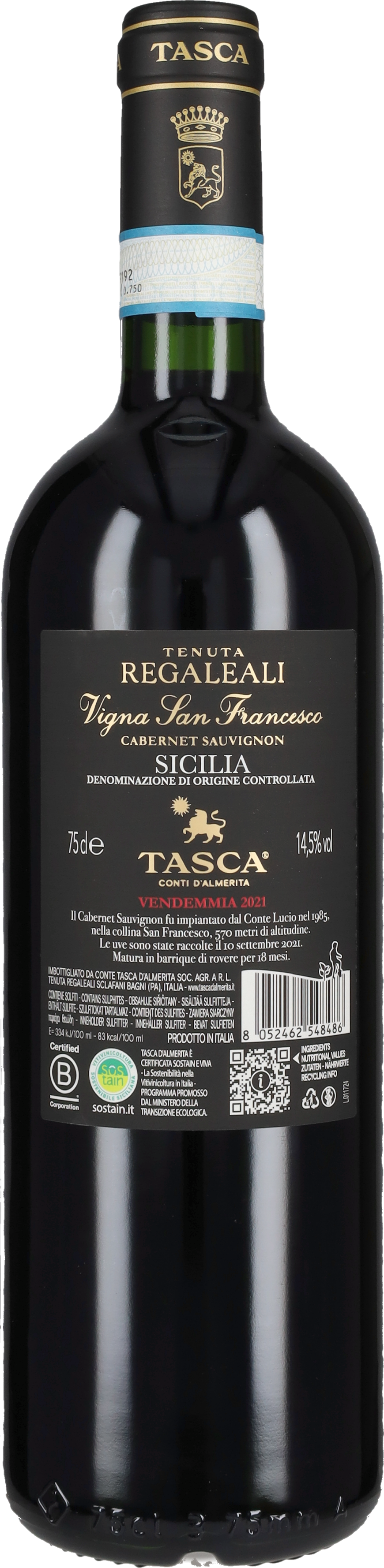
Cabernet Sauvignon 'Vigna San Francesco' Tasca d'Almerita 2021Il Cabernet Sauvignon ‘Vigna San Francesco’ di Tasca d’Almerita – Tenuta Regaleali costituisce una pregiata etichetta sicula che spicca per generosità e carattere, tra i primi Cabernet Sauvignon in purezza prodotti in Sicilia. Delle diverse tenute di proprietà della famiglia Tasca d’Almerita, Tenuta Regaleali è quella storica, situata al centro dell’isola nell’antica Contea di Sclafani e acquistata nel lontano 1830 dai fratelli Tasca. La vigna San Francesco, che fu impiantata da Lucio Tasca nel 1985, rappresenta poi l’emblema della proprietà, sempre indirizzata verso l’innovazione e la ricerca della massima qualità. Il Cabernet Sauvignon Tenuta Regaleali – Tasca d’Almerita ‘Vigna San Francesco’ ha origine da sole uve Cabernet Sauvignon cresciute su un terreno franco sabbioso-argilloso, leggermente calcareo, tra i 530 e i 585 metri sul livello del mare. La vendemmia manuale è accompagnata da un’attenta selezione dei grappoli, che vengono quindi ammostati in vasche di acciaio inox per la fermentazione alcolica associata a circa 20 giorni di contatto tra il mosto e le bucce. La fermentazione malolattica viene svolta completamente e la massa è quindi posta a invecchiare per 18 mesi in barrique di rovere francese nuove, realizzate con legni di Allier e Tronçais. Tasca d’Almerita – Tenuta Regaleali Cabernet Sauvignon ‘Vigna San Francesco’ è di colore rosso rubino acceso e consistente. Intenso e scuro corredo aromatico descritto da profumi di frutti di bosco, liquirizia, pepe nero, tabacco, cannella e vaniglia che si uniscono a erbacei aromi varietali di salvia e menta. Sorso ricco, strutturato ed elegante, dotato di gustosa scia sapida e tannini morbidi. Un Cabernet Sauvignon siciliano pluripremiato dalla critica nazionale e internazionale, approcciabile anche in gioventù ma provvisto di incredibile longevità.40,00 £*Shipping: 48,00 £Secure redirect to the provider
-
Can the arts and crafts course still be completed?
Yes, the arts and crafts course can still be completed as long as the necessary materials and instructions are provided. Participants can follow along with video tutorials, written instructions, or attend virtual classes to learn and create art projects. Online platforms and resources make it possible for individuals to continue their artistic pursuits from the comfort of their own homes. With dedication and practice, participants can successfully complete the arts and crafts course and develop their skills. **
-
Should the religious heritage and Christian tradition of Europe be more clearly included in the European constitutional treaty?
The inclusion of religious heritage and Christian tradition in the European constitutional treaty is a complex and sensitive issue. While Europe has a rich history of Christian influence, it is also a diverse and secular society. Therefore, any inclusion of religious heritage should be done in a way that respects the diversity of beliefs and values within Europe. It is important to strike a balance that acknowledges the historical significance of Christianity while also upholding the principles of secularism and religious freedom. Ultimately, the decision should be made through careful consideration and dialogue among the diverse communities and stakeholders in Europe. **
-
What can you make in the first arts and crafts class with 5th and 6th grade students?
In the first arts and crafts class with 5th and 6th grade students, you can make simple and fun projects such as friendship bracelets, paper mache masks, or painted rock art. These projects are engaging and allow students to express their creativity while also learning basic crafting skills. Additionally, these projects can be completed within the class period and are suitable for students of varying skill levels. **
-
Is East Asian cuisine more varied than European cuisine?
Both East Asian and European cuisines are incredibly varied, with each region offering a wide range of flavors, ingredients, and cooking techniques. East Asian cuisine encompasses the diverse culinary traditions of countries such as China, Japan, Korea, and Thailand, each with its own unique dishes and flavors. Similarly, European cuisine is incredibly varied, with distinct culinary traditions in countries like Italy, France, Spain, and Greece. Ultimately, the variety of both East Asian and European cuisines is a result of the rich diversity of ingredients, cooking methods, and cultural influences found within each region. **
* All prices are inclusive of VAT and, if applicable, plus shipping costs. The offer information is based on the details provided by the respective shop and is updated through automated processes. Real-time updates do not occur, so deviations can occur in individual cases. ** Note: Parts of this content were created by AI.